
Airway & Myofunctional Dentistry: Beyond the Smile We don’t just fix teeth; we help your child breathe, sleep, and grow to their full potential.
What is Airway Dentistry?
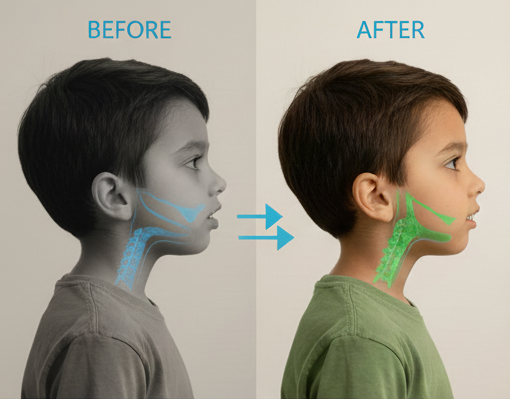
Most people think dentists only look at teeth. Airway Dentistry takes a broader view. It focuses on the relationship between the mouth, the jaw, and the airway. If a child’s jaw doesn’t develop correctly, it can restrict their breathing passage, leading to a host of health and behavioral issues.
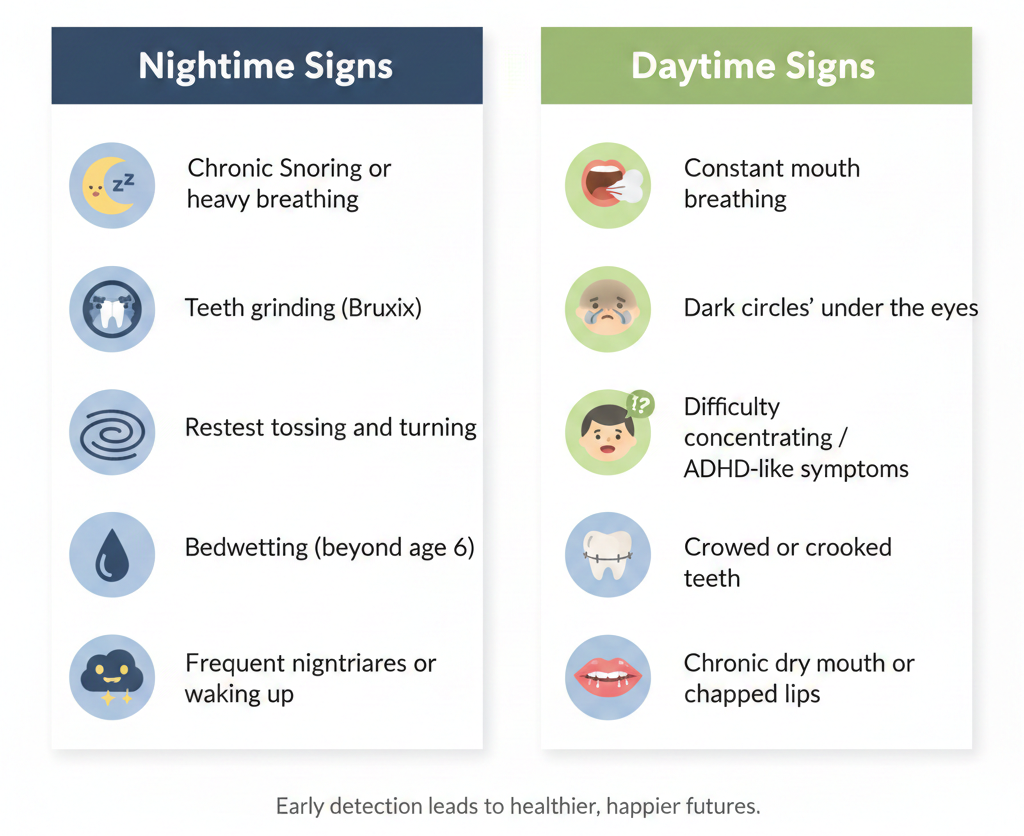
Modern science shows that mouth breathing and poor jaw alignment are often the root causes of snoring, restless sleep, and even difficulty concentrating in school. Our clinicians are specialized in identifying these structural issues early to ensure optimal oxygen flow and healthy development.
The Symptoms: Is Your Child At Risk?
Why It Matters: The Long-Term Impact
Oxygen is the fuel for growth. When a child’s airway is compromised, their brain and body don’t receive the restorative rest they need.
-
Physical Growth: Proper nasal breathing supports correct facial and jaw development.
-
Behavioral Health: Many children misdiagnosed with ADHD actually suffer from sleep-disordered breathing.
-
Dental Health: Airway issues are often the primary cause of crowded teeth; by treating the airway, we often reduce the need for complex braces later.
Our Specialized Approach
As the only certified provider of Myobrace® treatment in the UAE, Dr. Dina and her team use non-invasive, growth-guided techniques to:
-
Correct Habits: Retrain the tongue to sit at the roof of the mouth.
-
Restore Nasal Breathing: Move away from harmful mouth breathing.
-
Guide Jaw Growth: Widen narrow arches to make room for teeth and air.
Dr. Dina pioneered this approach in Dubai in 2010. Our clinic is a specialized referral center for myofunctional therapy, helping symptoms like snoring and attention deficits improve—or even disappear.
Q&A
Can my child outgrow these issues?
Generally, no. Without intervention, narrow jaws and mouth breathing patterns tend to set into permanent adult structures.
At what age should we start?
As early as 3 to 5 years old. Early intervention leads to the most natural and stable results.
Does a narrow jaw always mean I have a breathing problem?
Not always, but it’s a major risk factor. A narrow arch usually means the tongue lacks space and is forced back into the throat, which can partially block the airway during sleep.
Why did my previous dentist never mention this?
Traditional dentistry focuses on “mechanical” repairs like fillings and crowns. Airway dentistry is a newer, systemic approach that looks at the mouth as a vital part of the respiratory system.
If I don’t snore, could I still have an airway issue?
Yes. You may have Upper Airway Resistance Syndrome (UARS), where your body works significantly harder to breathe without making the loud vibrating sound of a snore
If I do the exercises, can I skip the dental appliances?
Occasionally for mild cases, but usually no. Myo tones the “soft” tissues (muscles), while appliances expand the “hard” tissues (bone). You generally need both to keep the airway open permanently.
How much time do I need to commit to these exercises?
Most programs require about 5 to 10 minutes, twice a day. Consistency is more important than duration; it is like “reprogramming” your brain to keep your mouth closed.
I’m 40 years old—is it too late for my tongue to “relearn” how to rest?
Never. The brain retains neuroplasticity at any age. While it may take longer than it would for a child, adults can successfully retrain their resting tongue posture and swallowing patterns.
Will expansion create a large gap between my front teeth?
It is possible during the active phase of treatment. This is actually a positive sign that the bone is growing. We can usually manage the aesthetics during this phase with temporary solutions or Invisalign later.
Is this just a fancy version of a night guard?
No. A night guard protects teeth from grinding but can actually push the jaw back and worsen the airway. Airway appliances are designed to remodel the jaw or hold it forward to keep the airway open.
Will I need to wear a retainer forever?
If we successfully retrain your tongue to rest on the roof of the mouth, the tongue acts as a “natural retainer.” However, most doctors still recommend a night-time retainer to ensure the structural changes stay permanent.
Can this treatment help my child’s ADHD symptoms?
Many “ADHD” symptoms—inattentiveness, hyperactivity, and irritability—are actually symptoms of chronic sleep deprivation caused by mouth breathing. Improving the airway often leads to better focus and behavior.
How soon will I feel a difference in my energy?
Some patients notice an “opening” sensation within weeks, while others feel the primary benefits once the tongue is fully strengthened and the jaw has expanded, usually within 6 to 9 months.